Hospital renovation: Modernising buildings for the future with smart doors and windows
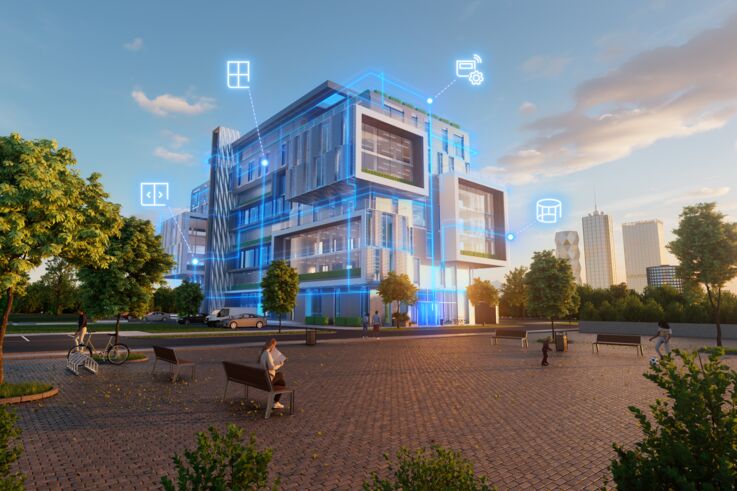
How can hospitals be modernised whilst continuing to operate, while at the same time improving efficiency, hygiene, safety and comfort? When renovating a hospital, it is worth taking a closer look at components that are often taken for granted in everyday life: doors and windows. As part of a connected building concept, automated door and window solutions can streamline processes, reduce the workload on staff and help to create a safe and comfortable environment for patients. At the same time, networked systems provide valuable information for facility management, maintenance and building automation.
Hospital renovation as an opportunity for digital modernisation
Hospitals are among the most complex types of building. Patients, healthcare staff, visitors and operators have different requirements in terms of comfort, safety and functionality. Added to this are regulatory requirements, hygiene standards and numerous technical systems that must work together reliably.
A hospital renovation, in particular, therefore presents an opportunity not only to replace individual components, but to develop the building’s infrastructure as a whole. Doors and windows should be taken into account at an early stage of the planning process. Ultimately, they are far more than merely functional components: when properly planned and networked, they become interfaces between physical infrastructure and digital building management.
Taking patient comfort into account during hospital renovation
In line with the principles of Healing Architecture, modern door and window solutions promote patients’ well-being and autonomy in day-to-day hospital operations. © lake.office / GEZE GmbH
Modern healthcare buildings should not only be functional, but also promote patients’ well-being. The approach known as “Healing Architecture” pursues precisely this aim. Smart window solutions can, for example, enable people with reduced mobility to let in fresh air independently at the touch of a button. Daylight, air quality and the ability to control these factors individually contribute to a pleasant indoor climate and a greater sense of autonomy. Modern door systems also impact the quality of the environment. Doors that close quietly can reduce the noise level in sensitive areas. Automatic doors make it easier to find your way around, improve accessibility and can help avoid stressful situations.
Automatic doors make life easier for nursing staff and doctors
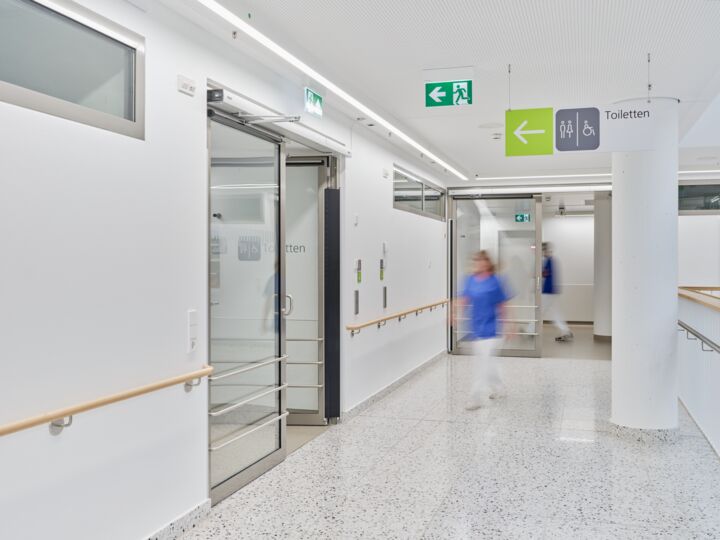
Automatic doors make it easier to transport patients and take the strain off nursing staff in their day-to-day work at the hospital. © lake.office / GEZE GmbH
When renovating a hospital, it is not only the technical infrastructure that should be taken into account. Another question is equally important: How can the building support the people who work there every day? Nurses and doctors often work under considerable time pressure. Automatic doors, for example, can make it easier to transport patients, beds and medical equipment, and reduce physical strain. For example, networked automatic doors can be controlled so that they adapt in advance to staff walking speeds or can be easily passed through by cleaning or care robots. Building envelopes that respond to temperature changes or indoor air quality relieve care staff of the need to worry about opening or closing windows and shutters. Non-contact solutions also reduce potential contact surfaces and can therefore support hygiene measures. Furthermore, if doors are integrated into call systems and IT systems, further processes can be automated.
The result: fewer unnecessary steps and interruptions, as well as more efficient processes in day-to-day hospital life.
Building automation brings transparency to hospital operations
Networking of doors and windows into building automation is of particular interest to operators and facility managers. When integrated into building automation and control systems, door and window solutions can provide data for monitoring, analysis and control. Usage data and status reports can, for example, help to
- identify areas with high footfall,
- optimise maintenance intervals,
- identify faults at an early stage and
- plan resources more effectively.
This provides greater transparency about actual building operation, particularly in large hospital complexes comprising several buildings.
Discover the myGEZE Control networking solution
Take security and critical infrastructure requirements into account
Hospitals are part of critical infrastructure. Security and availability requirements are correspondingly high. When renovating a hospital, it is therefore necessary to take a range of different requirements into account – for example, fire protection, emergency exit protection and access control, as well as the secure integration of networked systems. Open interfaces and standardised communication protocols help to ensure interoperability and future-proofing. At the same time, mechanical function remains crucial: in the event of an emergency, doors must operate reliably and keep escape routes clear in accordance with the applicable requirements. The challenge lies in finding the right balance between safety, comfort and automation.
Find out more about smart building automation for critical infrastructure-compliant buildings
Networked door and window technology as part of building automation
Networking is also a top priority in hospitals. © Jürgen Pollak / GEZE GmbH
The full added value of smart solutions comes from networking. Modern door and window automation can be integrated with systems for ventilation, heating, fire protection and access control. This enables, for example, doors to open as required, ventilation systems to be supported and safety functions to be triggered automatically. At the same time, data is generated that can be used for maintenance planning and investment decisions. This makes building operations more transparent and easier to plan.
Taking the entire life cycle into account in hospital renovation

Teaser white icon hand © GEZE GmbH
For building operators, factors to consider include not only the capital costs of modernisation but also maintenance, energy consumption, the risk of downtime and the building’s future adaptability. Standardised, networked systems reduce complexity and simplify maintenance. Forward-looking planning makes retrofitting easier – particularly in the healthcare sector, where care provision structures, patient numbers and building requirements can change. Future-proof hospital renovations take these developments into account right from the start.
We calculate how quickly your investment in building automation will pay for itselfOur GEZE experts will be happy to advise you. © lake.office / GEZE GmbH
Planning hospital renovation early on and in a holistic manner
Smart door and window solutions can be a key component of modern hospital infrastructure. They promote comfort and hygiene, can ease the workload on staff and provide greater transparency in building operations. Particularly in the case of renovation and modernisation projects, it is therefore worth incorporating doors, windows and their networking into strategic planning at an early stage. This is because subsequent adjustments may incur additional costs or result in opportunities going untapped. In the case of complex renovation projects carried out whilst the building remains in use, working with BIM models can also help to improve the quality of digital information.